Expressing desire, pursuing dreams, loving oneself, questioning the oppressive confines of patriarchy. Farida Baqi takes us on a lyrical and emotional journey through the life of a young woman from birth to adulthood in an unnamed Arab city.
The moment of birth, the possibilities of childhood, the growing pains of teenage years, the expectations imposed by society on young women: The Visual Feminist Manifesto explores how a woman’s life is crafted by the world around her. We are witness to the ways in which she makes meaning, both from her personal experience and how she is told she must behave, both deeply shaped by patriarchal structures. Repeatedly told that women are “less than”, her behaviour is made small by the threats of shame, fear, and ostracisation. All the while, she is seeking something more emancipatory. Farida Baqi brings us into the fold through the life of an unnamed woman in an Arab city, homing in on the experience of a cisgender woman making encounters with heterosexual desire. But the filmmaker’s ode will resonate with many, united through universal emotions of joy, pain, love, and frustration.
Contrasting shots depicting the urbanity of an Arab city and the gentle scenery of the seaside, Baqi makes a woman’s life inextricable from the spaces and places around her, all the while hinting at a more liberatory future forged through solidarity.
Section: Internationaler Wettbewerb
-
Visual Feminist Manifesto, The
-
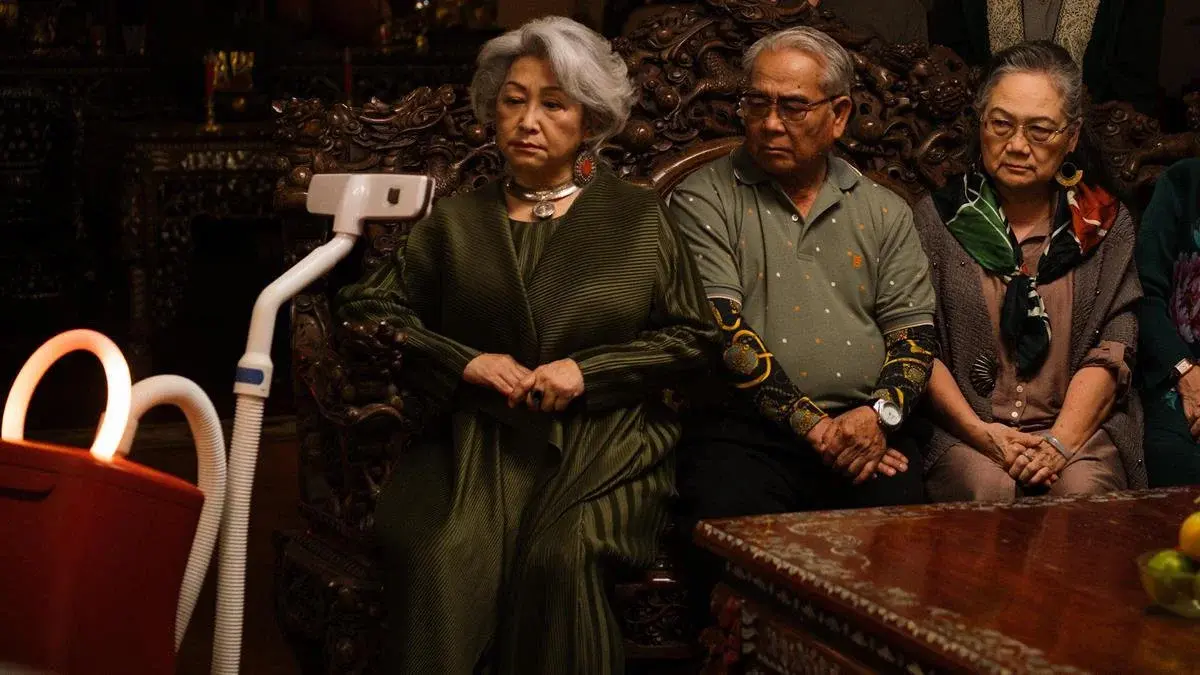
Useful Ghost, A
March is mourning his wife Nat who has recently passed away due to dust pollution. He discovers her spirit has returned by possessing a vacuum cleaner. Being disturbed by a ghost that appeared after a worker’s death shut down their factory, his family reject the unconventional human-ghost relationship.
Trying to convince them of their love, Nat offers to cleanse the factory. To become a useful ghost, she must first get rid of the useless ones.
-

I Only Rest in the Storm
Sergio travels to a metropolis in West Africa to work for an NGO as an environmental engineer on a road project between the desert and the forest. There, he becomes entangled in an intimate yet unbalanced relationship with two inhabitants of the city, Diara and Gui. As neo-colonial dynamics among the expatriate community unravel, this fragile bond becomes his only refuge from an impending collapse into solitude or barbarism.
-
Adamant Girl, The
Meena stubbornly refuses to speak. She loves a man from a lower caste. Her family thinks she is possessed and the spell is cast out of her. The day begins, a road movie starts, as religious fervour and insane misogyny are narrated in passing.
What director P.S. Vinothraj makes of this little story is as impressive as it is entertaining. With great visual humor, he tells of the stoic perseverance of his heroine, while patriarchal chaos reigns around her: the relatives of the man to whom she was promised talk at her, insult and threaten her; her own family remains embarrassed and powerless; the rooster, which is to be brought as a sacrifice, collapses. The director shows the mania for masculinity and real violence relentlessly and at the same time cleverly undermines them again and again with the means of cinema. And Meena counters this with her silence. -
When the Phone Rang
This story centers around a phone call that was received one Friday in the spring of
1992. The main protagonist is an eleven year old girl. Being the only person at home,
she is the one to answer the phone. The call arrives from another state delivering news
of a death. It is this call that seemingly disintegrates the country and the girl’s entire reality. The war that will ravage the country has already started but the war is not the center of this story, only its backdrop. This call, which brought news of her grandfather’s death, remains as the most vivid memory in the girl’s mind decades later, as a constant presence.
The film thus proceeds as a creative investigation into remembrance and the creation
of personal and collective myths. The phone call as a recurring event in the story
brings together a series of recollections which are assembled to build a larger story.
Each memory is called forth by a phone call, and thus the film is divided into eleven
events, eleven phone calls. Each event begins with a phone ringing and ends with the
packing of suitcases and departure.While the first call brings news of her grandfather’s death, the second call comes from
a mafia boss with the code name “Lajavi” or “ The One Who Barks” who wants extortion money and threatens the girl’s father. The family quickly takes the girl out of
school, bags packed and drives to Belgrade. At this point both of her parents carry
guns. The next call is in comparison mundane, and comes from Olja, a classmate from
school. She calls at an agreed time to listen to the girl play the piano. In this way she isable to drown out the noise of the outside world, in which dead cats hang on tree
branches and teenagers knife each other in the streets over sneakers. When the phone
rings again, this time it’s Siniša, the owner of the video club “Panda”. He’s asking for
the VHS tapes to be returned before he needs to administer a late fee. In her hurry to
obey, the girl accidentally returns her father’s porn tapes. Another segment takes us to
the neighbor’s house. Vlada is a prolific drug user and a skinhead, together they watch
MTV. Their fun is interrupted by a phone call from her mother, instructing her that the
time has come to pack.Together the events all add to the larger story of departure, the reasons for which are
all outlined in the details and nuances of the segments. Finally, they coalesce to illustrate the heartbreak, dislocation and tearing as experienced by a young girl in crisis stricken Yugoslavia of the 1990s. -
Silence of Reason
Forensic video essay built as a performative research into the first international criminal tribunal case to enter convictions for war rape as a form of torture and for war sexual enslavement as crime against humanity. Built solely from forensic visual archive and testimonies, Silence of Reason acts as a memory itself: elusive, fluid, rejecting framing, moving in all directions, spatial and temporal. The singular experiences of violence and torture to women from the Foča rape camps during the war in Bosnia and Herzegovina become our own collective memories, surpassing time and space.
-
Evidence
Vergiftetes Wasser, verseuchter Boden und steigende
Krebsraten: Umweltsanierungsflächen sind eine der
Hinterlassenschaften des US-amerikanischen Chemie- und
Munitionskonzerns „Olin Corporation“. Eine weitere ist die
John M. Olin Foundation, die zwischen den 1970ern und
frühen 2000ern mit Millionenspenden konservative Inhalte
vorantrieb. Ob als Nebeneffekt oder bewusst gesteuert, hatten
die Olin Corporation und andere konservative Think Tanks
tiefgreifenden Einfluss auf Amerikas Politik, auf Familienwerte
und die Frauengesundheit. In ihrem neuen 16mm-Essayfilm
des New Left Cinema verknüpft Lee Anne Schmitt eine ganze
Reihe von Themen, Büchern und Objekten und reflektiert das
Erstarken der Neocon-Bewegung sowie die Auswirkungen des
Dark Money auf die US-Politik und Kultur. In ihrem zweifellos
bislang persönlichsten Film – ihr eigener Vater arbeitete
für Olin – beginnt Schmitt, kurz nachdem sie selbst Mutter
wurde, über diese Werte und ihre Folgen nachzudenken.
Angesichts der erschreckenden Angriffe auf das biologische
Selbstbestimmungsrecht der Frau und die gegenwärtige
Dominanz der Republikaner ist EVIDENCE ein ernüchterndes
Lehrstück zum Zustand der heutigen USA. (Ted Fendt)